
When persistent symptoms may have become learned
Persistent symptoms can be all consuming, deeply disruptive and very distressing, especially when medical investigations have not found an ongoing disease process or structural problem that fully explains why they continue.
You may already have come across the idea of neuroplastic pain or neuroplastic symptoms and wondered whether it could help explain your own experience. Perhaps your symptoms fluctuate, move or change in ways that do not seem to fit a simple structural explanation. You may notice that stress, expectation, attention or particular situations influence them. Or you may have been told that your nervous system has become sensitised but have been left unsure what that actually means or what you can do about it.

Neuroplastic Recovery Therapy is designed for people in this position. It provides a structured way of assessing whether learned protective processes may be contributing to persistent symptoms and, where they are, helping the brain and nervous system begin to respond differently.
We feel these sensations in our body, even when they are generated from the brain. Your symptoms are real. The aim is not to persuade you that they are psychological, but to understand why the nervous system may still be producing protection when the body is safer than the symptoms suggest.
Book a Neuroplastic Symptom Recovery assessment
What do we mean by neuroplastic symptoms?
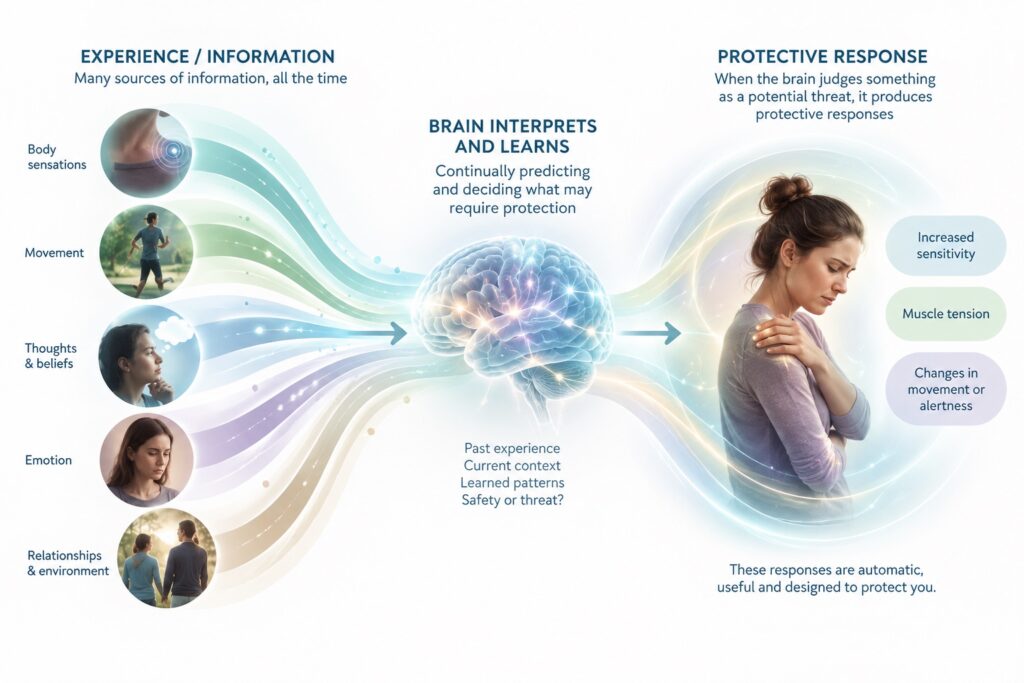
The brain is constantly interpreting information and making predictions about what is happening in and around the body. It uses sensory information, but it also draws on previous experience, expectation, attention, emotional state and the wider context.
This predictive process is normal and essential. It allows the nervous system to respond quickly to possible danger and helps us navigate the world efficiently. Problems can arise, however, when the system has learned to expect threat in situations, movements or bodily sensations that are no longer actually dangerous.
When protection becomes over-predicted or too easily triggered, the resulting symptoms can be very real. Pain is one example, but protective responses can also be experienced as fatigue, dizziness, headache, nausea, gastrointestinal symptoms, breathlessness, muscle tension, sensory changes and other persistent physical experiences.
Calling a symptom neuroplastic does not mean that it is imagined, exaggerated or voluntary. It means that learning, prediction and nervous system protection may be playing an important part in why the symptom persists. If the symptoms are neuroplastic, treatments directed towards the tissues are not always effective and do not get at the underlying drivers for the problem.
Although this might seem like a fringe theory to some. The science is sound. The International Association for the study of Pain, pretty much the world authority on pain, have recognised the phenomenon of pain without tissue injury and have re-classified their system of chronic pain to accommodate pain that exists as a primary disorder and not secondary to tissue strain or disease (IASP).
How do we decide whether this explanation fits?
We do not assume that symptoms are neuroplastic simply because tests are normal, and a diagnosis or scan finding does not automatically rule neuroplastic mechanisms in or out.
Instead, we look for positive evidence in the overall pattern.
It may be relevant if symptoms fluctuate substantially, move or spread over time, appear in situations that are physically safe, or have developed a growing number of triggers. We may also notice that symptoms change according to expectation, attention or emotional state, become worse when closely monitored, or reduce unexpectedly when someone is distracted, absorbed, confident or engaged in something enjoyable.
Sometimes symptoms persist far beyond expected healing. Sometimes their intensity seems out of proportion to the physical findings. In other cases there may be genuine structural or medical findings, but those findings do not seem to explain the whole picture.
No single feature proves that a symptom is neuroplastic. We look at the history, medical context and behaviour of the symptoms together and ask whether learned protective processes provide a convincing part of the explanation.
Symptoms are protective, not meaningless
The nervous system is designed to protect us. Pain, fatigue, dizziness and other symptoms are not random events. They are experiences produced by a biological system trying to respond to what it believes is happening.
That does not mean the system is broken. It may simply have learned to become more protective than is now necessary.
An injury, illness, frightening symptom, period of high stress or repeated experience of symptoms can all contribute to learning. Once the brain begins to expect danger, it can start responding more quickly and strongly to the same sensations or situations. Attention narrows, confidence reduces, behaviour becomes more protective, and the nervous system receives more evidence that the situation must be unsafe.
The encouraging part of this model is that learning is not fixed. If the nervous system can learn protection, it can also update its predictions when it repeatedly receives different evidence.
A Framework for understanding Threat, protection and neuroplastic recovery
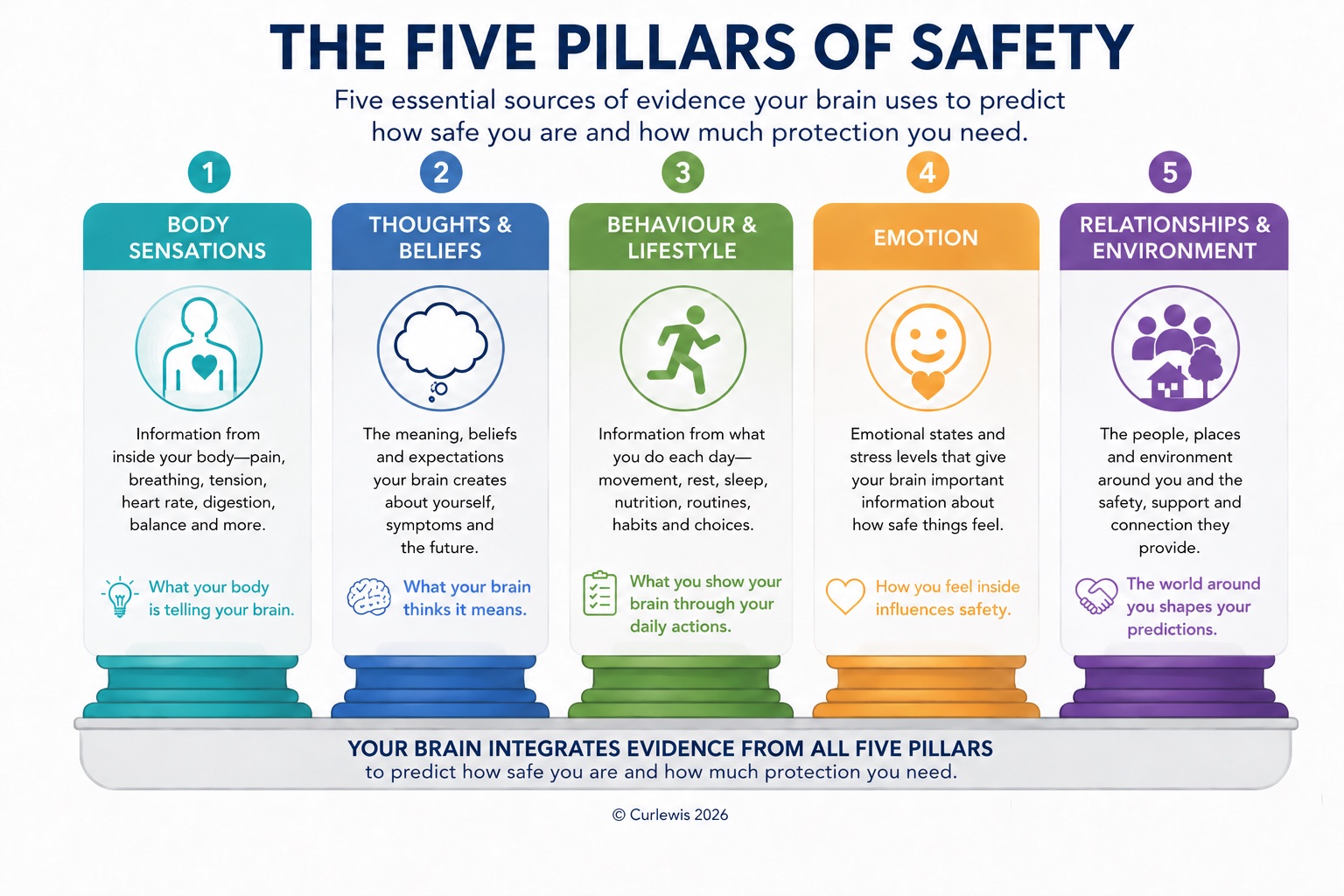
The brain does not judge whether we are safe or threatened from one source of information alone. It continually draws on what is happening in the body, what we expect and believe, how we respond, our emotional state, and what is happening around us.
We use the Five Pillars of Safety Learning©. This is simply an organising framework devised by Graham Curlewis as a way of structuring these different sources of information. They help us understand why the nervous system may still be predicting that protection is needed, and where new experiences may help that prediction begin to change. Treatment is not limited to one approach but remains flexible depending on the assessment of what we call “threat drivers” keeping the nervous system in protective mode. The approach is based on the work of John E Sarno, SIRPA and the ATNS (Association fro the Treatment of Neuroplastic Pain – Howard Schubiner, Dave Clark, Alan Gordon etc)
Body Sensations
Pain, tension, movement, fatigue and other physical sensations all provide information to the brain. Previous injury or illness can also influence how those sensations are interpreted. A sensation that has become associated with danger may trigger protection even when the body is now safe. We use Pain Reprocessing Therapy (PRT) to change the way we approach the sensations.
Thoughts & Beliefs
What we believe symptoms mean can strongly influence how threatening they feel. Expectations about damage, vulnerability, activity or recovery can increase protection, while a more accurate and reassuring explanation can provide very different information. Our thoughts and beliefs influence our actions and our emotions, which can again be a source of ongoing threat. This is a key component of both PRT and EAET.
Behaviour & Lifestyle
Avoiding movement, bracing, checking symptoms, repeatedly testing the body, or alternating between pushing through and withdrawing from activity can unintentionally reinforce a sense of danger. Different experiences can gradually demonstrate that the body is safer and more capable than expected.
Emotion
Emotions are normal biological experiences, but some feelings can become associated with danger, particularly when they have previously felt difficult, unacceptable or overwhelming. Where this is relevant, learning that emotions themselves can be safely experienced may form part of recovery. We use various techniques to improve the felt sense in the body, improving emotional awareness and expression (EAET).
Relationships & Environment
The nervous system is also influenced by the world around us. Connection, support and a sense of choice can provide evidence of safety, while conflict, isolation, uncertainty, excessive demands or feeling unable to be ourselves can add to the overall sense of threat.
The Five Pillars approach is simply a structured way of asking what evidence the nervous system may currently be using to assess threat and where different opportunities might exist to increase safety.
How recovery happens
Neuroplastic recovery is not about trying to force symptoms away or repeatedly telling yourself that you are safe. Change usually comes through learning experiences. Safety is felt, not thought.
If a movement has become associated with danger, recovery may involve gradually discovering that the movement is safer than expected. If a bodily sensation has become frightening, treatment may involve learning to notice it without automatically interpreting it as a threat. If checking, avoidance or bracing have become habitual, experimenting with different responses can provide the nervous system with new information.
The same principle can apply to emotions, activity, relationships and other areas of life. The aim is to create experiences that do not match the old prediction of danger.
Over time, these experiences can provide new evidence. New evidence allows the brain to update its predictions, and when less protection is predicted to be necessary, symptoms may begin to reduce.
This is why recovery is better understood as a process of learning than as a battle against symptoms.
What might treatment involve?
Treatment is individual rather than formulaic, although there are milestones that most people will go through. People need to build confidence in the neuroplastic explanation before anything else. Some people already understand the theory well, but find that their body continues to react as though something is wrong.
Treatment may involve education about how neuroplastic symptoms develop, exploring the evidence that supports the diagnosis, and helping you reinterpret familiar sensations in a less threatening way. We may use Pain Reprocessing Therapy principles, somatic attention, behavioural experiments and graded approaches to movements or activities that have become associated with danger.
We may also work with protective behaviours such as checking, bracing, avoidance or repeatedly testing symptoms. Where emotional processes appear relevant, treatment can include carefully exploring feelings that have become difficult, suppressed or threatening using principles informed by Emotional Awareness and Expression Therapy.
For some people, stress regulation and nervous system settling are useful parts of treatment. For others, the priority may be reducing symptom monitoring, rebuilding confidence in activity, changing beliefs about vulnerability or addressing demands within relationships or daily life.
Where genuine physical impairments, deconditioning or loss of capacity are also present, physiotherapy rehabilitation can be integrated into the same recovery process. Neuroplastic recovery does not require us to ignore the body or stop using physiotherapy where it is useful.
Our work draws on Pain Reprocessing Therapy, SIRPA approaches, Cognitive Functional Therapy, Emotional Awareness and Expression Therapy, contemporary pain science organised using the Five Pillars of Safety framework.
Book a Neuroplastic Symptom Recovery assessment
This is not simply about stress, trauma or hidden emotions
It is easy for mind body approaches to be misunderstood as saying that physical symptoms are caused by stress or by unresolved trauma. That is not how we approach neuroplastic recovery.
Stress and emotion can be relevant because they influence the same nervous system that produces physical protection, but they are only part of the picture. Not everybody has a history of trauma. Not every symptom has an emotional cause. You do not need to uncover a hidden memory or identify a particular feeling in order to recover.
Likewise, having anxious thoughts or paying attention to symptoms does not mean you have caused the problem yourself. These are often understandable responses to persistent and unexplained symptoms.
The more useful question is not, “What psychological problem is causing this?” but, “What has the nervous system learned to treat as threatening, and what experiences might help it learn something different?”
What symptoms might this approach be relevant to?
Neuroplastic mechanisms can contribute to many different persistent physical symptoms. These may include:
- persistent or widespread pain,
- recurrent pain,
- fatigue,
- dizziness,
- headaches or migraine-type symptoms,
- gastrointestinal symptoms,
- nausea, breathlessness,
- persistent muscle tension,
- sensory symptoms eg itching and
- combinations of several fluctuating symptoms.
These experiences can, of course, have many different medical causes. Neuroplastic Recovery Therapy is appropriate only when the overall clinical picture suggests that learned protective mechanisms may be contributing and when appropriate medical assessment has taken place.
The aim is never to explain away symptoms that require further medical investigation. The approach can be complementary to normal medical treatment but never replaces it. It is important to understand the state of the tissues under the skin. As pain is not a reliable indicator of tissue damage, we need to be alert to the possibilities of medically appropriate symptoms that need that intervention first.

Who is this service for?
This service may be particularly suitable if you already suspect that your symptoms may have a neuroplastic component, have read about approaches such as Pain Reprocessing Therapy or SIRPA, or have been told that your nervous system is sensitised but are unsure how to move forward.
It may also be helpful if medical investigations have not fully explained your symptoms, if symptoms fluctuate or move in ways that seem inconsistent with structural damage, or if you recognise that attention, expectation, stress or particular situations influence how you feel.
Some people come to us having already read extensively about neuroplastic pain and understand the theory very well, yet still feel stuck. Knowing intellectually that symptoms may be safe is not always enough. Recovery often depends on helping the nervous system experience that safety rather than simply thinking about it.
If your symptoms are new, have not been medically assessed where appropriate, or there are signs suggesting further medical investigation is needed, we will advise accordingly.
What happens at the first consultation?
We begin by understanding the whole symptom history: where appropriate how the problem started, how it has changed, what investigations and diagnoses you have had, what treatment you have tried and what explanations you have been given.
We then look carefully at whether a neuroplastic explanation fits the pattern. Rather than relying simply on the absence of pathology, we look for positive evidence in the way symptoms behave and consider whether other medical or physical contributors still need attention.
We also begin exploring the Five Pillars to understand which sources of threat and safety may be most relevant to you. This might include fear of symptoms, beliefs about damage, checking or avoidance, emotional stress, activity patterns, relationships or other aspects of life that appear to influence protection.
From there, we identify the main barriers to recovery and begin deciding what new experiences are likely to be most useful. The first consultation is intended to start making sense of the problem and beginning treatment, not simply to give you another label.
You do not need complete certainty
One of the common difficulties in neuroplastic recovery is feeling that you must be completely certain that the symptoms are neuroplastic before you can improve.
Confidence in the explanation can develop gradually as we review the evidence and as you begin having experiences that fit the neuroplastic model. A movement turns out to be safer than expected. A symptom changes when the context changes. Something that was previously feared becomes manageable. The nervous system begins receiving information that does not match its old prediction.
You do not have to convince yourself of something you do not believe. We work with the evidence and allow confidence to grow from experience.
The aim is recovery
Our goal is not simply to help you manage symptoms indefinitely.
Recovery may involve symptoms becoming less intense, less frequent and less frightening. It may mean returning to activities that had become difficult, trusting your body again, reducing the amount of time spent checking or monitoring symptoms, and allowing life to become larger than the symptom experience.
The aim is not to manage the symptoms, but to reduce them substantially or resolve them altogether. This can happen quickly for some, for others, change is more gradual. We cannot promise a particular outcome, but neuroplasticity means that learned protective patterns are not necessarily permanent.
Specialist neuroplastic recovery at Physis
This specialist service is currently provided by Graham Curlewis and Ola Szyszczakiewicz, physiotherapists with additional training and experience in persistent pain and neuroplastic symptom recovery.
Because the work is grounded in physiotherapy as well as contemporary pain science and mind body approaches, physical and neuroplastic contributors do not have to be treated as competing explanations. Where both are relevant, both can be addressed.


Not sure whether your pain is neuroplastic?
If your main problem is persistent or recurrent pain and you are not yet sure whether neuroplastic mechanisms are relevant, you may prefer to begin with our Persistent & Recurrent Pain Physiotherapy service.
That appointment takes a broader physiotherapy-first approach and helps work out what combination of physical and learned protective factors may be contributing.
If you have recently injured yourself and need help with settling the symptoms or building yourself back up and want to explore more regular physio, you can book an initial physiotherapy session here.
You do not need to have all the answers before you come
If you think neuroplastic mechanisms may be contributing to your symptoms, you do not need to arrive with a definite diagnosis or complete confidence in the explanation.
Working out whether the model fits you, and what recovery might involve, is part of the consultation.