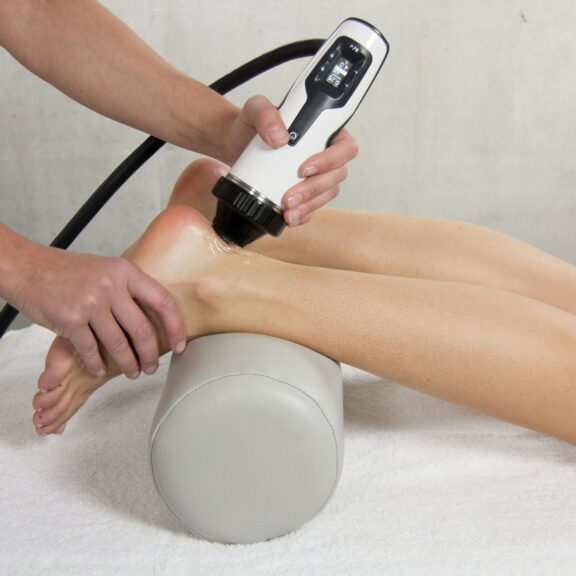
Shockwave therapy is an evidence‑based treatment that can significantly reduce pain and improve function in people with chronic insertional Achilles tendinopathy, particularly when combined with a structured physiotherapy programme.
Shockwave therapy for insertional Achilles tendinopathy is an excellent adjunct to standard physiotherapy management in patients with significant levels of pain here’s why. Like most tendinopathy treatment plans exercise therapy including a strength plan are absolute key therapy options but progress can be difficult by the heel pain patients suffer. Using shockwave therapy for insertional Achilles tendinopathy helps to get control of the pain quickly and progress suitable exercise therapy in around 80% of patients. It’s a great non invasive alternative to steroid injection or surgery and its available with no waiting lists at Physis Physiotherapy in Edinburgh. So what do patients need to know from this blog?
What is insertional Achilles tendinopathy?
Insertional Achilles tendinopathy is a common cause of posterior heel pain in both sedentary and active people. It is often a chronic, frustrating injury which effects active adults aged between 30 and 60 years of age, particularly those who are engaged in regular sporting activity such as running (Zhang et al., 2020; Furia, 2006).
It is characterised by pain, swelling, morning stiffness and tenderness on the attachment of the Achilles tendon onto the heel bone, known as the calcaneum (green circle on the image below).
The other common type of Achilles tendon injury is called mid-portion Achilles tendinopathy. This injury is located above the heel bone towards the muscle belly (blue circle on the image below). Both mid-portion and insertional Achilles tendinopathy can be a very painful and debilitating condition which can be difficult to treat.
What causes insertional Achilles tendinopathy?
Insertional Achilles tendinopathy is associated with injury and/or overuse. However, while the exact cause is often unknown, there are certain risk factors such as impact based sports and activities such as running, tennis, volleyball and football. This condition is particularly common in runners who have:
- increased their mileage too quickly
- started running too often
- recently incorporated hill training
- changed their running shoes
Some individuals are genetically prone to tendon issues particularly those with collagen (connective) tissue conditions. Those who are overweight, diabetic or have high cholesterol are also more likely to get insertional Achilles tendinopathy and often these patients take longer to fully recover. Advancing age has also been shown to be a known risk factor.
Other intrinsic risk factors include overpronation (flat feet), stiffness in the ankle joint or hips and/or a leg length discrepancy (Furia, 2006).
Is shockwave therapy for insertional Achilles tendinopathy effective?
Shockwave therapy is an effective option for treating chronic insertional Achilles tendinopathy, particularly when other nonoperative treatments have failed such as physiotherapy, rest, orthotics and medication (NSAIDs) have failed to produce satisfactory results (Al-Abbad and Simon, 2013, Mani-Babu et al., 2015).
The use of shockwave therapy for Achilles tendinopathy is well supported by the National Institute for Health and Care Excellence (NICE). NICE provides national guidance and advice to improve health and social care. It provides evidence based recommendations to guide best practice within healthcare.
Studies have found statistically significant improvement for outcomes of pain and function at 4-month follow-up in the shockwave group following the use of shockwave therapy in over 80% of patients.
A large case-control study (Furia, 2006) demonstrated shockwave was statistically significantly better in improving pain. In fact, an average pain reduction of 50% was experienced by the patients.
It is concluded that shockwave therapy is more effective than physiotherapy and rehabilitation alone for insertional Achilles tendinopathy. In one study, the more sports-active patients had better clinical outcomes than non sports-active patients after 5 years of follow-up (Zhang et al., 2020). This study also showed that following a course of shockwave therapy the symptoms continue to improve for several years afterwards. Furthermore, there was a very low reoccurrence rate in the shockwave group. This is particularly important because typically Achilles problems have a high reoccurrence rate.
How many sessions of shockwave therapy are needed?
Scientific research indicates that typically 3-4 shockwave sessions approximately one week apart is recommended. Some patients require more than three sessions due the chronicity of their problem, but it will also depend on how you respond to your initial treatment. This does vary from person to person depending on the exact nature and extent of the injury. It is not unusual to feel an immediate reduction in pain following your first shockwave session and you can continue with your exercise rehabilitation plan. The likely scenario is a gradual reduction in pain over the following weeks to months. Which will be a useful adjunct to strength exercises in your recovery.
How long does it take to recover ?
Some insertional Achilles tendinopathy can settle within a few months or even up to 18 months. This does vary from person to person depending on the exact nature and extent of the injury. It is not unusual to feel an immediate reduction in pain following your first shockwave session but a more likely scenario is a gradual reduction in pain over the following weeks to months.
Key takeaway points:
- Shockwave therapy can reduce pain by up to 50% in chronic cases
- Non invasive alternative to steroid injection or surgery
- Ideal candidates have had Achilles pain for greater than 3 months
- Contraindications include malignancy near site and infection
- Most patients require 3–4 sessions
- Best results occur when combined with progressive loading exercises
- NICE supports its use for insertional Achilles tendinopathy
Author
Darren Cornforth and a team of experienced shockwave therapists provide care for Physis Physiotherapy patients. Darren has been using shockwave for over 10 years and has undergone extensive training. All of our clinics provide shockwave therapy but certain conditions require specific treatment protocols and your therapist will help direct you with the best clinical advice. Our physiotherapy team have extensive experience treating chronic Achilles tendinopathies using shockwave therapy.
Last updated 4/5/2026
References
Rompe, J.D., Furia, J. and Maffulli, N., 2008. Eccentric loading compared with shock wave treatment for chronic insertional achilles tendinopathy: a randomized, controlled trial. JBJS, 90(1), pp.52-61.
Wei, M., Liu, Y., Li, Z. and Wang, Z., 2017. Comparison of clinical efficacy among endoscopy-assisted radio-frequency ablation, extracorporeal shockwaves, and eccentric exercises in treatment of insertional Achilles Tendinosis. Journal of the American Podiatric Medical Association, 107(1), pp.11-16.
Zhang, S., Li, H., Yao, W., Hua, Y. and Li, Y., 2020. Therapeutic Response of Extracorporeal Shock Wave Therapy for Insertional Achilles Tendinopathy Between Sports-Active and Nonsports-Active Patients With 5-Year Follow-up. Orthopaedic Journal of Sports